I published a small web tool, generated with Codex, to explore how measurement errors affect a logistic growth forecast. A logistic curve describes growth that slows and approaches a limit. If you fit one using only three early measurements at equally spaced times, small errors can lead to very different estimates of that limit.
The collection now has 18 patterns. This update adds three patterns and makes focused changes to five existing ones. The new patterns cover evidence quality, decisions under uncertain future conditions, and causal claims. I also clarified when an AI should contribute during shared work.
The revisions make several checks explicit that were previously implicit. The checks do not show that an AI using the patterns produces more accurate answers.
My notes repository stores sources, concepts, and investigations. Sources preserve what another author said. Concepts combine knowledge about one idea. Investigations record how I examined a specific question. I recently added a fourth kind of note that records how to reason about many different questions.
I call these notes cognitive patterns. A cognitive pattern is a reusable reasoning procedure. It contains questions, steps, failure modes, checks, and an example of how the same procedure can work in another field.
The goal is to make the reasoning between a question and an answer easier for a human and an AI to inspect together. A pattern can help them choose a suitable procedure, notice missing checks, and improve the procedure after using it. It does not make the answer true. Evidence still has to support every claim.
Baidu released Unlimited OCR in June 2026. It is a vision language model for reading complete documents. It returns text, headings, tables, formulas, reading order, and the positions of page elements. The model can also read several page images in one request.
The model is small enough to run locally. It has 3 billion parameters in total, while its mixture of experts decoder uses about 500 million parameters for each token. I can run it on a MacBook Pro with an M4 chip and 24 GB of memory.
In June 2026, Google proposed the Open Knowledge Format, or OKF. I had already been keeping my notes as Markdown files in Git, so the proposal caught my attention. My setup already shared many of the same parts, but it did not follow the OKF rules. I wanted to know what I would have to change.
The adaptation required less work than I expected. I kept my notes system and defined which part of the repository is portable. I also added a clear entry point, made a few file rules explicit, and taught the existing notes skill to follow them.
A dependency is code that I allow to run on my machine and, eventually, in production. That makes every package installation a supply-chain decision. I recently added two small, complementary safeguards to Python Minimal Boilerplate: delay the adoption of newly published packages and audit the locked dependency set before every commit.
I recently had the opportunity to present at the 14th Belgian Python User Group (PUG) meetup. The event was kindly hosted by Datashift at their offices in Mechelen on January 22, 2026.
It was a fantastic evening of technical deep-dives and community networking. You can view the original meeting announcement and attendee list on Meetup.
Some of the smartest people working on AI disagree about where it is going. Not just on timelines, but on fundamentals. Some argue that progress will slow because we are hitting physical limits. Others believe that new breakthroughs will unlock systems far more general than anything we have today. Still others argue that the very idea of “superintelligence” is a distraction.
For a long time, I found this disagreement confusing. These are people with access to the same research, the same models, and often the same data. If anyone should agree about the future of AI, it should be them.
Over time, I started to suspect that the disagreement wasn’t really about technology.
It was about what counts as success.
When people talk about AI “winning,” they often mean different things. Sometimes they mean being first. Sometimes they mean being most capable. Sometimes they mean building something that looks impressive on a benchmark or in a demo. These goals are easy to measure, and they dominate public discussion.
They are also insufficient.
For me, advanced AI is only a success if three things are true:
its benefits are broadly shared rather than concentrated,
it makes human work more rewarding instead of hollowing it out,
and it can exist within real physical and ecological limits.
Once I started looking at the AI debate through this lens, many disagreements made more sense. People weren’t talking past each other because they misunderstood the technology. They were optimizing for different outcomes.
This essay is an attempt to understand those differences—not to predict who will be right about AGI, but to ask a more practical question: how should organizations act when the technology is powerful, the future is uncertain, and the consequences are unevenly distributed?
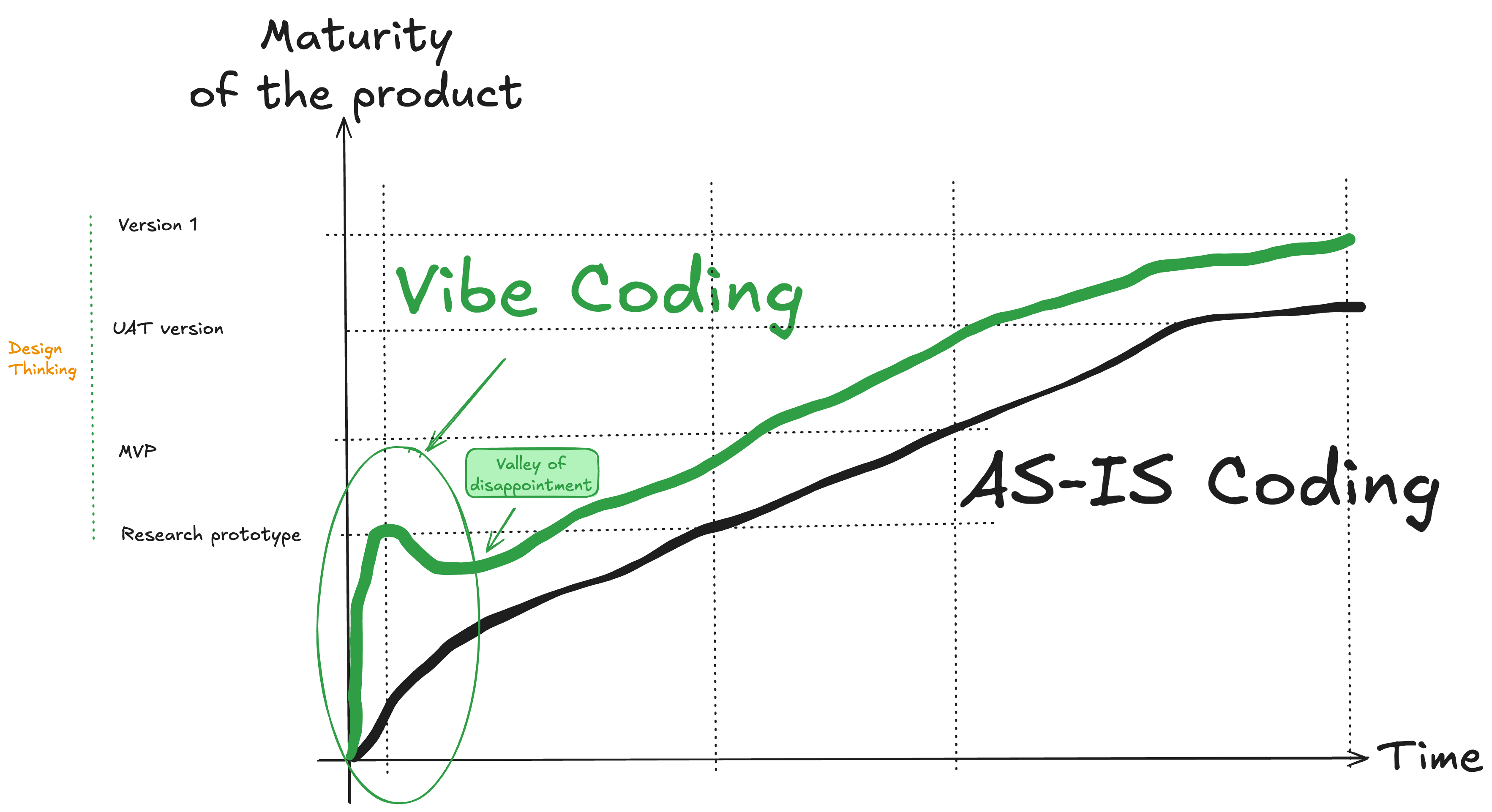
These new coding agents—along with Cursor, Lovable, Windsurf, V0, Bold.new, and others—are all tools that support some form of “vibe coding” (a term coined by Karpathy indicating AI-assisted coding).